
Sex Offender Checks in Cerro Gordo County
The Iowa Sex Offender Registry is the first public channel for a Cerro Gordo County sex offender search. Iowa's Division of Criminal Investigation runs the free system. It can filter records by county, city, ZIP code, address radius, name, telephone number, or email address. The registry began in July 1995 and carries a live update time. Its posted schedule says data updates hourly during weekday business hours.
The public registry is not the whole state file. It is a carefully limited view of data that Iowa law permits DCI to disclose. A map point may be imprecise, and a search that returns no match does not prove that no person is registered. For local help, the Cerro Gordo County Sheriff's Office performs registration and verification, supplies a countywide registrant list on request, and can answer a properly identified request for added public details.
Cerro Gordo Registry Office
People who register outside Iowa Department of Corrections custody report through county sheriff offices. In Cerro Gordo County, the registration point is the Law Enforcement Center at 17262 Lark Avenue. Weekday administrative hours are 8:00 a.m. to 4:30 p.m., and the published number is 641-421-3000. No appointment rule was posted, so call before going. Check the Cerro Gordo County department directory and the Cerro Gordo County Sheriff's Office page for current contact information.
A residence change must be reported in person within five business days. The same five-day period applies when a person who must register begins visiting or residing in Iowa. The sheriff checks the required information on a schedule tied to tier, takes a photo at least once each year, and may require more frequent checks when documented good cause exists. These local duties explain why a recent change can appear after a registration visit rather than at the instant a person moves.
How to Search the Iowa Sex Offender Registry
Begin at the official Iowa registry and read the user agreement. The agreement warns that the public view is not the complete registry, map accuracy is not guaranteed, automated scraping is barred outside authorized feeds, and the data cannot be used for threats or harm. A broad Cerro Gordo County registry search is useful for neighborhood awareness. A name plus another known fact is better when trying to identify a particular profile.
- Open the registry, review the terms, and accept the user agreement.
- Choose a mode, then enter a name, county, city, ZIP code, address radius, telephone number, or email address.
- Review the result list and compare aliases, physical traits, age, address, and distance before treating a match as the right person.
- Open the full profile and read the offense, tier, address, changed date, and any noncompliance notice in context.
| Field Label | Type | Required | Notes |
|---|---|---|---|
| Last and First Name | Text | No | Aliases can be included; the API supports starts-with last-name matching. |
| City, County, or ZIP | Text or criteria | No | Advanced search can include nearby city or ZIP results. |
| Address Radius | Address and miles | Radius is required | Enter address, city, state, ZIP, and a distance. |
| Telephone or Email | Identifier | By selected mode | The registry provides dedicated search modes for both identifiers. |
| Advanced Details | Criteria | No | Options include registry number, age, gender, size, location, and changed date. |
| Most Wanted | Name and place | No | Results can be limited to current or located noncompliance entries. |
The official Iowa registry landing page shows the search system before any Cerro Gordo County result is opened.
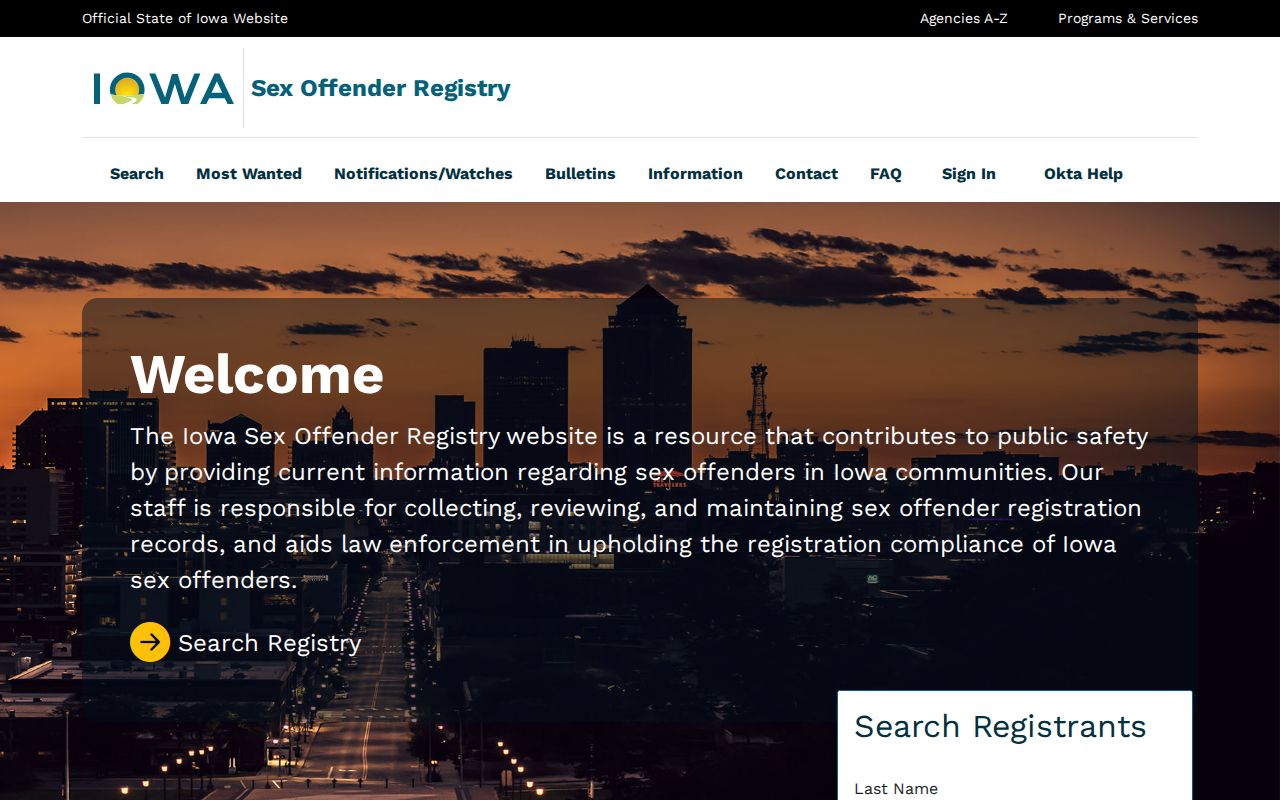
That starting screen keeps the agreement and search modes ahead of personal profile data, which helps a searcher choose a narrow and lawful query.
Cerro Gordo Registry and NSOPW
The Iowa registry is the more detailed source for a Cerro Gordo County search. The National Sex Offender Public Website, or NSOPW, is the useful second layer when a person may have moved across a state line or when the search area reaches beyond Iowa. The U.S. Department of Justice site sends a query across participating public registries. It does not replace Iowa's rules, local registration work, or the Cerro Gordo County sheriff's records.
The national registry search interface illustrates the cross-state route available after checking Iowa.
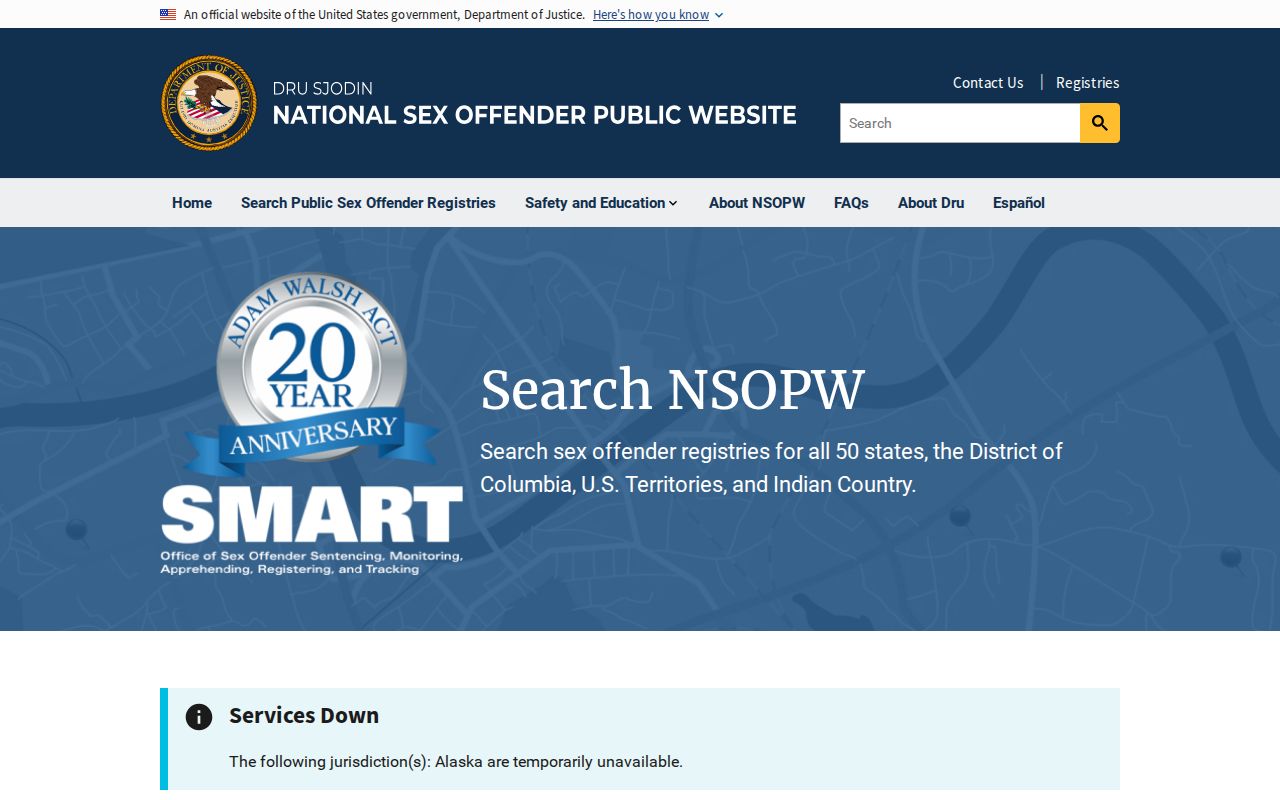
Use the national result to identify the source jurisdiction, then open that jurisdiction's official profile for its current public details and warnings.
Search scope is the key difference. Iowa offers local fields, tier data, notification watches, and state-specific public facts. NSOPW helps locate a possible record held elsewhere. If the two sources seem to conflict, use the listed registration jurisdiction and local law enforcement to verify the current status.
Inside a Registry Profile
A Cerro Gordo County public profile combines identity clues with registration facts. It may show more than one name, a photo, physical description, skin markings, address, distance from a searched point, offense text, statutory citation, tier, and a last-changed date. Victim identity is never a public profile field. The offense area may report victim age group, gender, and count in broad terms without naming a victim.
| Name and Aliases | Legal and middle names, aliases, registry system ID, and OCI number. |
|---|---|
| Photo and Description | Photograph, age or date of birth, gender, race, hair and eye color, height, weight, scars, marks, and tattoos. |
| Registered Address | Residence city, state, ZIP, county, map coordinates, distance, and possible address-cluster count. |
| Offense and Statute | Conviction text, Iowa statutory citation, age at offense, and limited victim group data. |
| Tier | The Iowa tier attached to the registration record, which controls verification frequency. |
| Registration Status | Last-changed date and a most-wanted or noncompliance flag when applicable. |
Some sensitive or extra fields stay off the website. The web profile does not publish a Social Security number, victim identity, fingerprints, palm prints, DNA, passport or state identification data, protected identity, employer, or school. The lack of a field should not be read as proof that DCI or the sheriff never collected it.
Cerro Gordo Registry Alerts
Iowa offers free notification watches through an Okta account. A subscriber may follow a city, Cerro Gordo County, a ZIP code, an address radius, one registrant, or a saved group. The registry homepage says an alert is sent within 60 minutes after a qualifying addition, deletion, or change. This is a practical way to monitor an area without rerunning the same registry search each day.
Choose the smallest area that answers the safety concern. A county watch is broad. A radius watch can focus on a home, school route, or other familiar place, while a specific-record watch follows one public profile. An alert signals that the source data changed. Open the official entry to see what changed, since the notice alone should not be used to guess at a move or status.
Note: Registry updates are posted hourly during weekday business hours, while alerts follow a qualifying record change and may arrive within 60 minutes.
Iowa Registration Levels and Requirements
Cerro Gordo County follows Iowa tiers for the minimum in-person verification schedule, but the tier number alone does not set a simple fixed registration term. Iowa Code §692A.106 generally calls for ten years, or the length of a special sentence when that period is longer. Revocation restarts the clock, a registry violation adds ten years, and specified aggravated, repeat, or sexually violent predator categories can require registration for life.
| Tier | Duration Rule | In-Person Verification | Public Visibility Note |
|---|---|---|---|
| Tier I | Generally ten years, subject to special-sentence and other statutory rules. | Once each year. | The tier can appear on a public profile; the public site is not the full registry. |
| Tier II | Apply §692A.106; the tier does not automatically mean 25 years. | Every six months. | The tier can appear on a public profile; the public site is not the full registry. |
| Tier III | Apply §692A.106; life depends on a listed statutory trigger, not the label alone. | Every three months. | The tier can appear on a public profile; the public site is not the full registry. |
An out-of-state registrant serves the longer applicable term. The Cerro Gordo County sheriff may also require more frequent verification for documented good cause. Iowa Code §692A.110 sets a $25 annual registration fee payable to the sheriff and permits added time, installment payments, or waiver under the statute.
Cerro Gordo Registry Residency Rules
The common claim that every person on the Iowa registry must live at least 2,000 feet from every school or child care site is wrong. Iowa Code §692A.114 applies that residence limit to the defined group convicted of an aggravated offense against a minor. The law also contains exceptions. A tier by itself does not answer whether the distance rule applies to a specific Cerro Gordo County profile.
The official Iowa Code chapter 692A listing is the source for the registry's duties, duration rules, public access, and residence limits.
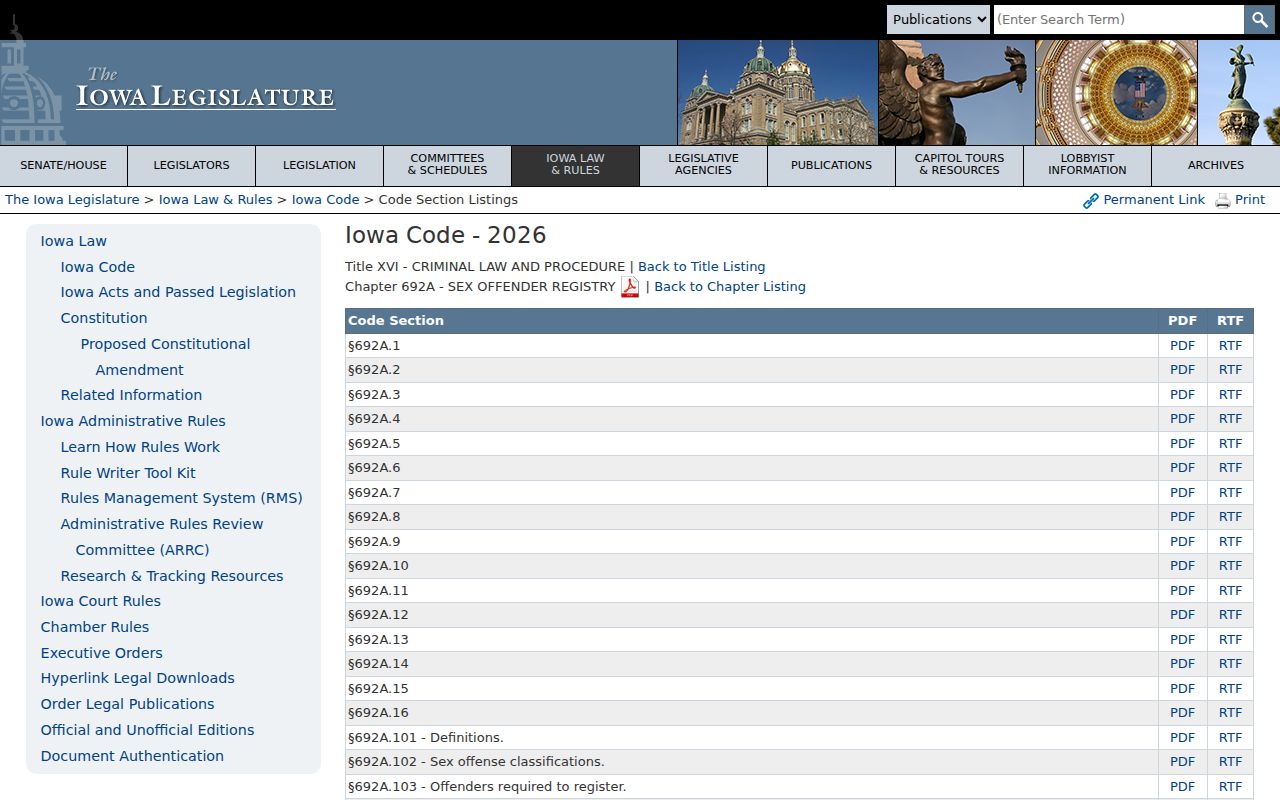
Read the cited section and the official profile together. A map pin or tier label alone does not establish whether the 2,000-foot rule applies.
Cerro Gordo Additional Registry Data
Iowa Code §692A.121 provides a second access channel when the online profile lacks a public fact needed to identify a specific registrant. A person may ask the Cerro Gordo County sheriff by telephone, in writing, or in person. The request must give the person's name and at least one identifier: date of birth, Social Security number, address, internet identifier, or telephone number.
For a properly identified request, the sheriff can provide the public web data plus school, employer, temporary lodging, and vehicle information. The statute says a sheriff or police department cannot charge for that request. It also requires the sheriff to provide access to a countywide registrant list on request. Protected data, including victim identity, DNA, fingerprints, palm prints, passport records, and Social Security numbers, stays confidential.
This statutory request is not a way to browse private files. Start with the public Cerro Gordo County registry profile, note the identifiers that support a precise request, and contact the Cerro Gordo County Sheriff's Office only for the added information that §692A.121 makes available.
Community Notification and Lawful Use
Cerro Gordo County registry records support awareness and safety planning. They do not grant power to confront, follow, detain, or punish anyone. A “Most Wanted” flag means the registry reports noncompliance. It is not permission to apprehend the person. Suspected noncompliance or a crime should be reported to law enforcement. In an emergency, call 911.
Community notice can come through the state website, the free watch system, and information released by the Cerro Gordo County sheriff as Iowa law permits. Check the profile date and source before relying on a result. If a map, address, or other field appears wrong, use the registry's correction instructions or contact the office that maintains the data.
Misuse can be a crime: Iowa Code §692A.121 controls public release of registry records, and Iowa's user agreement bars using them to threaten, assault, harass, or vandalize. Report suspected crime or noncompliance to law enforcement instead of acting against a registrant or household.